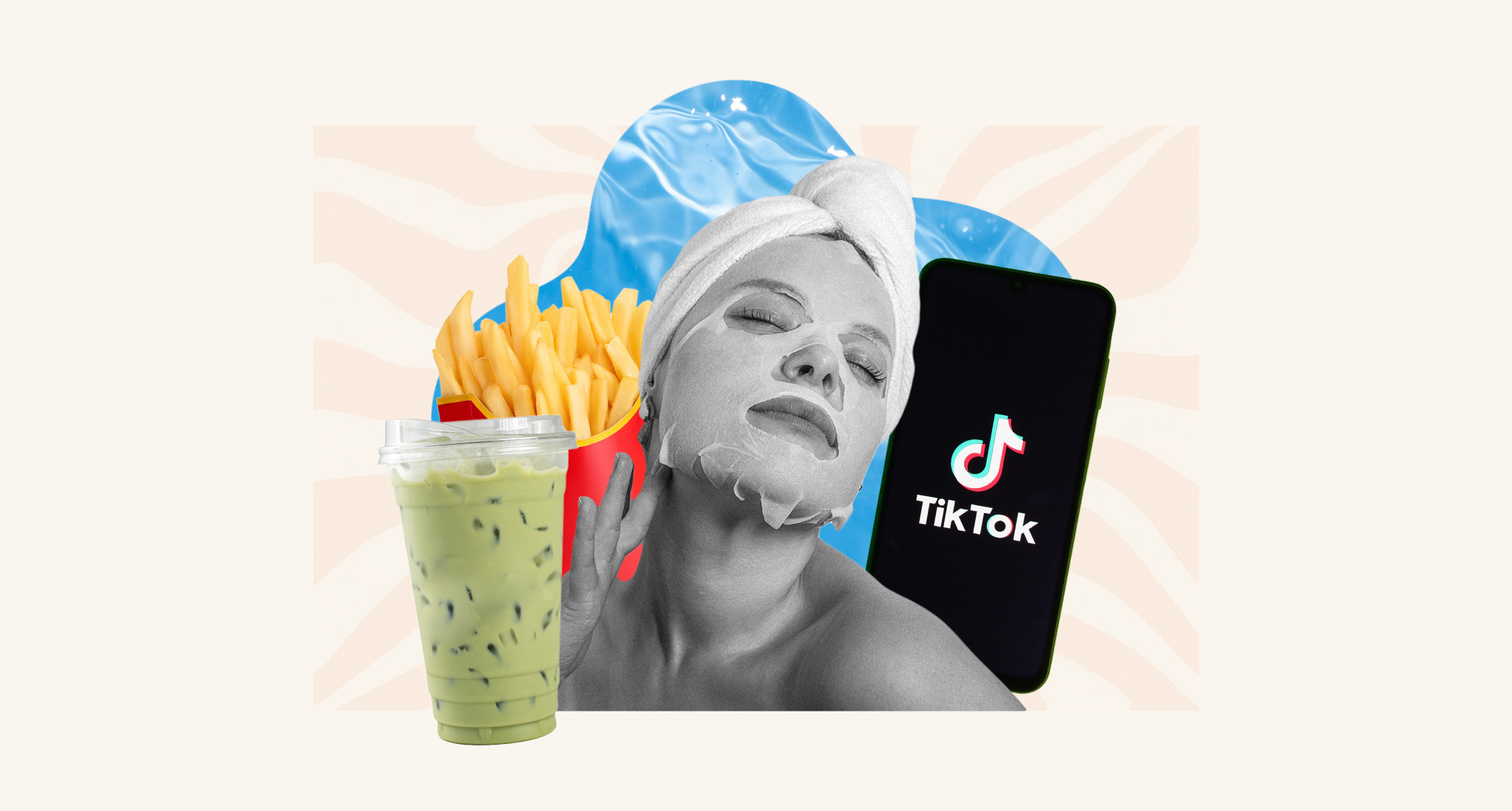
Whenever the New Year rolls around, the internet explodes with a bevy of wellness advice. The latest trend making the rounds on TikTok? Reaching the “flow state.” Content creators have appropriated the psychological term for pleasure—hundreds of videos depicting people claiming to have reached their “flow state” with what is usually a pile of food accompanied by a ubiquitous “crispy coke.” So is flow the self care of 2026? I spoke to a therapist to find out.
Is Flow the New Self-Care?
TikTok sure thinks so
•
Published Jan 30, 2026
Shutterstock
Meet the Expert
Dr. Suzanne Wallach, LMFT, is the executive Director of SoCal DBT. She holds a B.A. in Psychology from Ottawa University, Master’s Degree in Clinical Psychology from Phillips Graduate University and Doctorate in Psychology from The Chicago School of Professional Psychology.
The “Flow State,” Explained
While the term is being used rather facetiously on TikTok, it is a real psychological concept, Wallach asserts.
“What flow state really means is that you are in a state of ‘one mindfulness,’ where your attention is completely tuned in to what you’re doing,” she tells me. “You’re not focused on your worries, other thoughts or how you're doing at the activity you're engaged in. I think social media makes it sound like a euphoric state, and it isn't; it’s more like being so absorbed in the moment that any thoughts about yourself sort of float away.”
In other words, it may function, for some people, as a self-soothing mechanism—especially in today’s crazy world. Unlike overdrive, which is characterized by intensity and efficiency, the flow state isn’t meant to stress the body or be productivity on steroids.
“When a person is truly in a flow state, it feels steady and stable, as if you are naturally supposed to be there,” Wallach explains. “It isn't a frantic energy. If someone feels excited, tired or burnt out, that’s more likely cortisol and adrenaline, which would not be flow. Flow seems to happen when effort comes with ease.”
Why We’re in a “Flow State” Frenzy
Online, flow state feels like a mild parody that people liken to euphoria. In an attention-fractured media landscape, I was curious about the appeal of zeroing in and going all-out. Wallach pointed out that with all the overstimulation, distractions and pervasive screen time, achieving “one mindfulness” for even a few minutes seems impossible. We’re hooked on the impossibility, seeing what is akin to a feat being performed. Wallach notes that “flow state” is often overblown online when in reality, it’s a quiet phenomenon.
I recently reported that the year’s biggest flex will be the act of getting offline. Wallach tells me that the desire for the “flow state” is similar in that it reflects a nostalgia for a simpler life.
“People are tired of being on screens, distracted and constantly available to everyone. Wanting flow is really wanting to be more present in your own life, reduce chaos and increase balance,” she says. “Remember that the healthiest version of flow should come naturally—when your nervous system is in the right space, it shows up on its own.”