At the beginning of the year, I predicted that the biggest flex of 2026 would be the act of getting offline. From mega-celebrities to luddite teens, everyone is searching for a way to distance themselves from technology and get in touch with real life. Cue the analog renaissance. In January, Google Trends reported that searches for “analog bag” were at an all-time high and that “cell phone accessories for going analog” was a breakout search (meaning its search volume went up 5,000 percent). More recently, the search giant noted that “digital boundaries” had hit an all-time high at the beginning of spring. Combine that with the fact that I’ve seen Bluetooth-enabled landlines all over TikTok, I wasn’t surprised to see that an umbrella trend had been coined. Meet the concept of “ping minimalism.”
Gen Z Loves 'Landline Mode.' Here's Why My Cohort Is Exploring ‘Ping Minimalism’
Rotary phones are the hot new accessory

Meet the Expert
Dr. Sanam Hafeez is a New York City-based neuropsychologist and director of Comprehend the Mind, a psychological practice that treats learning disorders, anxiety, depression and other psychopathological disorders. Dr. Hafeez obtained her Doctor of Psychology at Hofstra University and completed her post-doctoral training in neuropsychology and developmental pediatrics at Coney Island Hospital.
I did not receive a cell phone until I was about 15; I didn’t get a smartphone until I was 17. At the time, it was mortifying to be left out of the conversations raging in Facebook Messenger and over text. But looking back, the adult me is grateful. Now, I live with an onslaught of messages—phone calls, emails, text messages, Whatsapps—that rain down like Cloudy With a Chance of Meatballs after the FLDSMDFR begins to malfunction and create spaghetti tornadoes. And, no surprise, it’s exhausting to be constantly plunged into a dopamine pool only to come up sputtering. Curious about why notifications managed to stir up curiosity, dread, obligation and fear, I turned to neuropsychologist Dr. Sanam Hafeez.
“There's a social survival instinct buried in there,” she explains. “Humans are wired to respond to signals from other people, and your brain doesn't really know the difference between a text from a friend and an actual threat that needs your attention. So that urgent feeling you get when you don't check it isn't weakness or bad habits, it's your biology doing exactly what it was built to do, just in a world it was never designed for.”
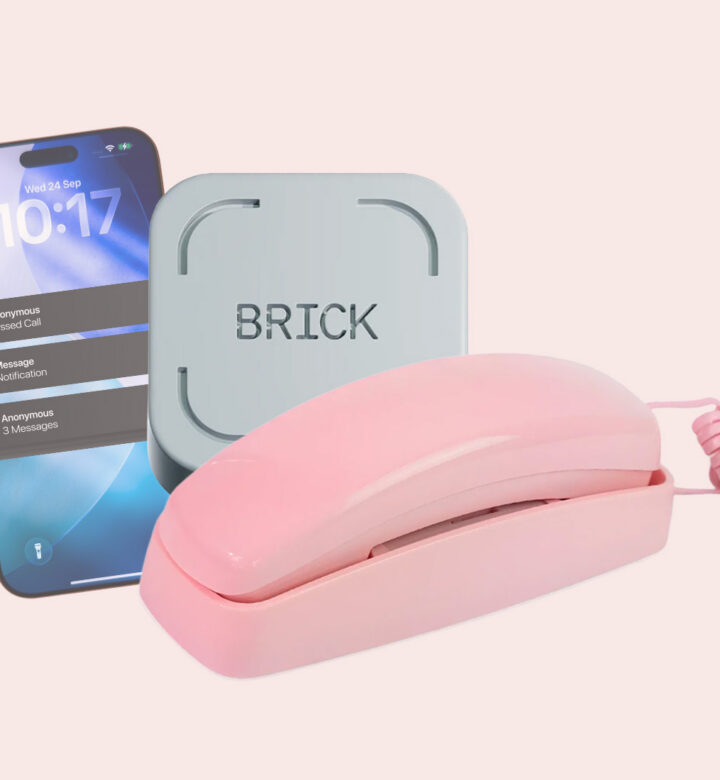
The dopamine crash-out has led many Gen Zers, the first chronically online generation, to opt for “dumbphones,” which is the colloquialism for a flip phone. One of the originators of the trend has been Cat Goetze, the creator behind the viral Physical Phones. The “landline” uses Bluetooth so that you can make calls via your smartphone, without the distractions of having a screen in front of you. Those who haven’t jumped all-in on dumbphones have opted for Brick, a physical square that blocks access to anything you deem a distraction. That means if you want to log back into Instagram but you’re out at brunch, you’ll have to wait until you go home to tap the Brick and unlock the app. The whole point is to create so much friction that it becomes inconvenient to be hyper-connected.
One creator remarked that having a landline “healed her inner child.” Another gleefully proclaimed she could finally slam the phone on her ex. But no matter the reason, ping minimalism has proven an appealing strategy in Gen Z’s quest for “digital boundaries.” While it might sound like a trendy catchphrase, there is merit, according to Dr. Hafeez.
“Without boundaries, you're in a constant low-level state of stress without even realizing it. Setting boundaries isn't about being difficult; it's about protecting your mental health,” she says. “Simple things actually work, such as turning off notifications, not responding to work messages after a certain hour or leaving your phone in another room. The world will not fall apart if you're unreachable for an evening, and your nervous system will genuinely thank you for it.” But beyond the (important) benefits to one’s mental health, I know that personally, I find something incredibly comforting in what one TikToker dubbed “physical media.” And, as it turns out, it does something to the brain, too.
“Physical media has a start and an end, and in a world of infinite scroll, that kind of boundary is quietly really comforting,” Dr. Hafeez notes. “A lot of it is sensory too, like the smell, the texture, the act of turning a page [that] engages your brain in a way that a swipe just doesn't. And just like the landline phone, it ties back to a time that felt slower and less overwhelming.”
While I’ve long toyed with the idea of getting a Bluetooth landline, I haven’t quite gotten around to it. For now, I’ve settled for turning off all notifications except texts and calls, and I might even get myself a Brick. Because being offline has never been more enticing.