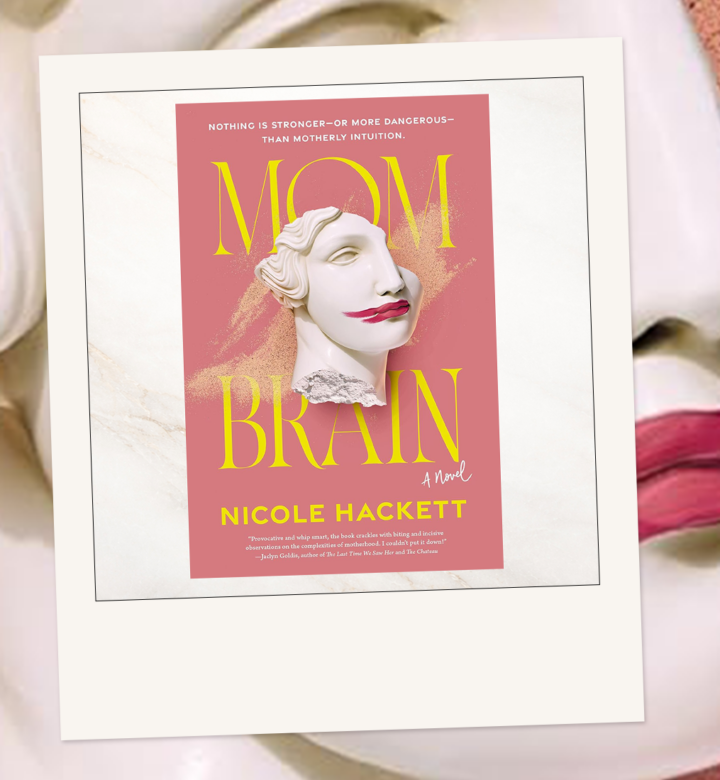
Editor's Note: As a mom herself, Nicole Hackett understands all too well the foggy feeling of 'mom brain.' In fact, it inspired her sophomore novel, in which a mom of two—who's recently been dubbed the "worst mom on the internet"—joins The Program in O'ahu, a week-long experience that promises to help women regain a sense of control over their lives. Aptly titled Mom Brain, the book is a total page-turner, and to celebrate its launch, we asked Hackett to share her real-life experience with mom brain with us.
It's More Than Mom Brain—It's Synaptic Pruning
AKA The Necessary Losing of My Mind

•
Published Apr 22, 2026
PureWow editors select every item that appears on this page, and some items may be gifted to us. Additionally, PureWow may earn compensation through affiliate links within the story. All prices are accurate upon date of publish. You can learn more about the affiliate process here.
Harper Collins Focus

“I want to be a good mom,” I said to my husband in a rare moment of vulnerability almost eight years ago. “I want to, but I don’t know if I can.”
I remember the moment like it was yesterday: We were lying on our bed one random weekday with now unfathomable freedom, having the sort of uninterrupted conversation that can only be had without children calling from the bathroom to wipe their poop.
But it wasn’t the interruptions that worried me about motherhood. It wasn’t even the poop. For some reason, with absolutely no evidence to support my confidence, I was sure I could handle that.
What worried me was whether I could achieve the level of motherhood that I would find acceptable—which, as a terminal high-achiever, was high. When I run, I run marathons. When I write, I write books. I’m wired in such a way that I had a vision board in kindergarten. I looked at that pair of rollerblades on my wall every morning and kindergarten-ed harder than anyone has ever kindergarten-ed before.
I rarely do anything I don’t know I can master, and I knew what mastering motherhood looked like: a woman sacrificing her money and her relationships, her freedom and her sleep. “And have you heard about mom brain?” I panicked to my husband, because I knew the final and most important thing a good mother must sacrifice is herself.
I wanted to be a woman who could do this, but at that point, I had no reason to think I was. And in my mind, that doubt alone was reason enough not to try.
I don’t know if my husband shared my doubts that day, but if he did, I’ll never know. He’s an exceptional man, so he just listened quietly, then reminded me of all the hard things I’d endured before.

It turns out moms aren’t forgetful because we’re so stressed. We’re forgetful because parts of our brain have been hollowed out.
That’s how I saw motherhood at the time: an act of endurance. A long struggle that, if survived, would be rewarded with life’s sweetest prize. I don’t know exactly where I got this idea from, but I suspect it came from the same place we got the phrase “mom brain.”
You know the phrase I’m talking about, the one moms say with a guilty little laugh. We say it when we lose our keys, then find them later in the refrigerator. When we cry at baby diaper commercials and the end of Toy Story 3.
We say it sometimes without realizing the magnitude of what we’re describing, because the truth is, mom brain isn’t just hormones. We don’t just need more sleep. When a woman becomes a mother, her brain actually changes in measurable, structural ways. We go through a process called “synaptic pruning,” which is more or less exactly as it sounds: a mini, biological DOGE. Neural connections are slashed, unnecessary synapses cut. The goal is to allow us to better focus on our children, but as we all know, every goal has a consequence. It turns out moms aren’t forgetful because we’re so stressed. We’re forgetful because parts of our brain have been hollowed out.
And yet, despite my doubts, I did end up getting pregnant that year, and then again two years after that. And I can tell you now with absolute certainty that my vision of motherhood wasn’t totally wrong.
I have sacrificed much to be a mother: money and freedom and sleep. (So much sleep.) And yes, in many ways, I sacrificed parts of myself.
That day in our bedroom, talking to my husband, I was not scattered or forgetful. I was the conductor of a tightly kept schedule, an incessant planner, a perpetual keeper of the clock. I did this because I knew control meant safety, and safety was the key to happiness in my mind.
I operated like this for years, having just enough control that I thought complete control—and therefore, happiness—was in reach.
And then I had kids.
To the person I was before becoming a mother, the chaos of young children would have been intolerable. And in the beginning, it very much was. I’ve always struggled with anxiety, but those early years were a different level. For each sweet memory I have, I have another with a wearable breast pump, crying in an airport bathroom stall.
That same synaptic pruning that makes you more forgetful can also make you more empathetic.
As time went on, something started changing. It wasn’t the chaos. Everything is still a mess most of the time. What changed is how I interact with the messiness. With every minor crisis I managed, the chaos stopped feeling so dangerous, until finally I stopped seeing it as a threat. I saw chaos instead as a phase that would end eventually, because that’s what it always was.
It was a small shift in perspective, but it fundamentally changed how I live my life. Not only did it make the chaos easier to manage, but now I even cherish it at times. I look around my messy house, and I don’t see a threat to my safety. I see proof—proof of the children who were here today and will wake up tomorrow as someone new.
And that’s the whole truth of motherhood, the complete story we don’t always tell. It’s crying at the diaper commercials, yes, but only because you know how it feels to kiss your own baby. It’s forgetting where your keys are but remembering that everyone is someone’s son or daughter. Because that same synaptic pruning that makes you more forgetful can also make you more empathetic. As a mother, your brain is literally structured for love.
And yes, it’s a mess. It’s crayons and stickers and those weird little squishy toys on all your counters and in all your drawers. It’s knowing you should clean them up but leaving them anyway, because you know how it’ll feel when they’re gone.
It’s watching my daughter spin like a ballerina. Marveling at my son’s sketch of a hammerhead shark. It’s having so much to do but doing these things anyway, because I’d happily trade all the money and freedom and sleep in the world for a glimpse of these miracles before they’re gone.
The truth is that mom brain is real, but it’s not broken. It’s a language you only understand once you speak it, and it’s the only way some things can be described. To be a mom is to know it will be excruciating, but also to be certain that it was never something to be endured.