It happened about three quarters of the way through their third date. My friend Elena had been hitting it off with Jerrod, a man in an open marriage she’d met on a dating app geared towards flexible partnerships. Throughout their time together, he’d been impressively communicative about, well, everything—his feelings, his relationship with his wife and the rules of their marital arrangment. But when he brought up a form he wanted Elena to fill out outlining the boundaries of their budding relationship, she was…taken aback. “Really? Do we need to be this formal about what we do and do not want from this?” she thought to herself. But also, “Why do I find this actually kind of sexy?”
“My Date Gave Me a Form About Our Open Relationship…and I Kind of Loved It”
Experts, on the other hand, aren’t so sure
•
Published Oct 3, 2025
Dasha Burobina for PureWow
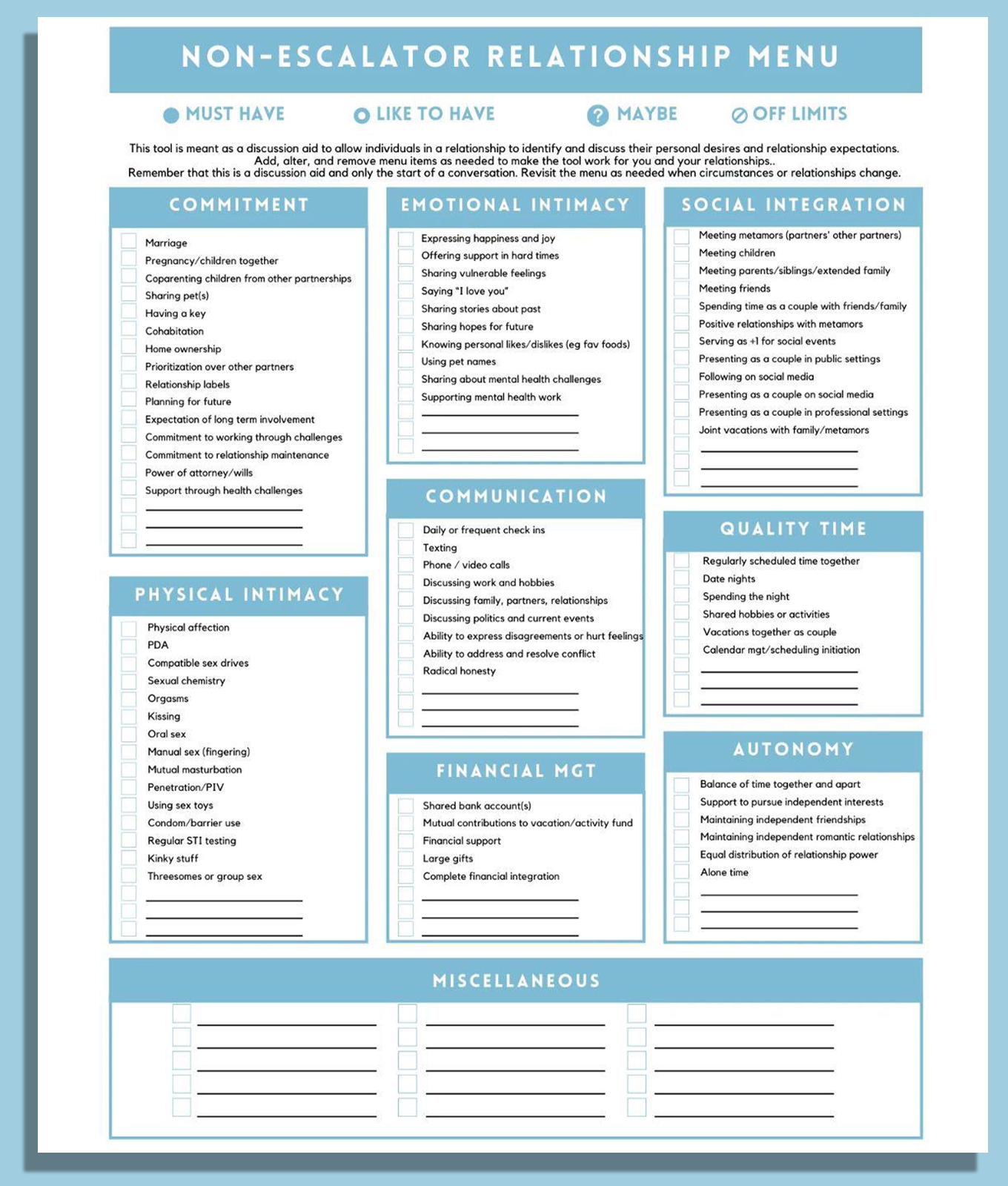
the relationship form in question
As Jerrod explained, the form in question was really just a tool. Elena was to fill it out, or at the very least read it through, before their next date when they could compare notes and ensure their relationship met both their needs and wants. The form included eight different sections, and tackled everything from physical intimacy to communication styles. How would she feel about only ever spending the night at her place, never his? Was it OK to follow him on Instagram? What about following his wife?
And while the experts I spoke to did acknowledge that the content was well-worth considering, they had misgivings about the coldness of a form in lieu of a conversation.
As Dr. Nicki Monti, a licensed marriage and family psychotherapist, put it, “Reading this form took me right to the doctor’s office. Have we really become so micro-managing and disconnected that we need a form to stimulate the articulation of our needs, wants, and perspectives?”
And when I showed the form to two friends also involved in open relationships, they echoed Dr. Monti’s initial aversions. “It just feels very rigid and, honestly, deeply unfun,” said Owen, 28, who is currently dating a woman in an open marriage. “It gives me the same feeling as all the folks you see on dating apps who have a strict list of what they want in a partner—over 6 feet tall, makes X amount per year, loves to ski, etc. You can’t boil your ideal partner down to a couple of keywords. This form just makes me feel like if I do or don’t check the wrong box, it’ll be the excuse my date needs to say, ‘next!’ without giving us a chance to even get to know each other.”

What I was attracted to wasn’t the form itself; I was attracted to his confidence and straight-forwardness.”
Still, there’s something about the honesty the experts can get behind with Dr. Monti acknowledging that, “if this can encourage people to take the time to consider what they truly want and need in a relationship, that’s great.”
And according to Elena that’s exactly how Jerrod wanted them to use it. “It wasn’t like a contract he wanted us to sign,” she says. “He’s just a very blunt and up-front kind of guy, and I think the bluntness of having things listed out for us to go over was appealing.” Upon further reflection, this was what Elena found so sexy about Jerrod’s proposal. “What I was attracted to wasn’t the form itself; I was attracted to his confidence and straight-forwardness.”

Maskot/Getty Images
So perhaps the form itself isn’t so bad, but the key, say the experts, is to remain flexible. Dr. Monti warns against trying to set firm standards. “As in any relationship, things [about the relationship] are discovered organically,” she notes. “Trying to totally control how, what and when is usually disastrous.”
Though Elena and Jerrod’s relationship eventually petered out, their parting had nothing to do with the form or his need for written clarity, which she actually still stands by. “That was something I really loved about him,” she says. “But I do hope he’s moved away from the form—I think a lot of women wouldn’t take it as well as I did.”