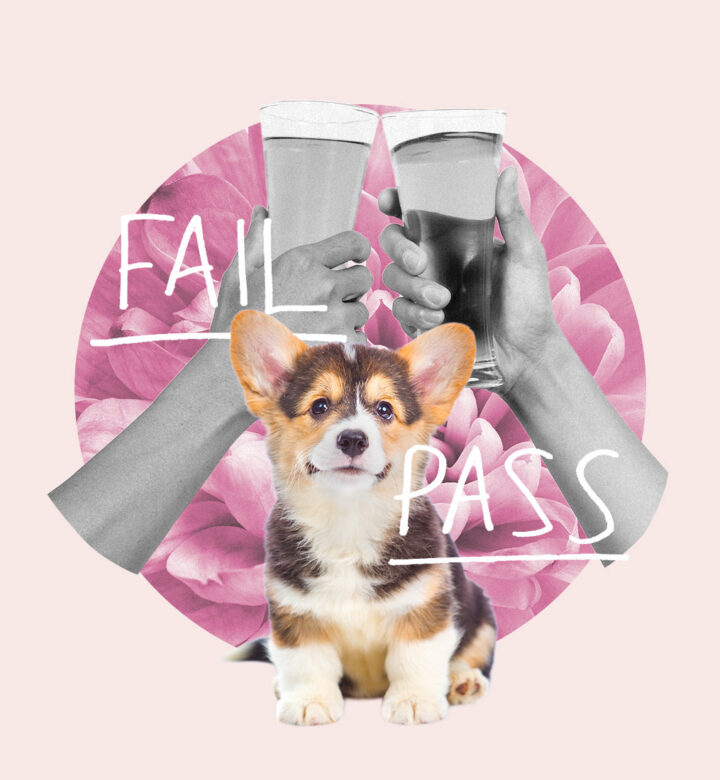
As a personality types aficionado, I love a good relationship theory. From the 3:6 rule to pineapple dating, each new term offers a window in how to get a good read on people. Recently, a colleague introduced me to the “two beers and a puppy” test, and the parameters had me intrigued. Essentially, it asks two questions: Can you have two drinks with someone, enjoying their company and conversation throughout that time? And, would you trust them to babysit your (hypothetical) puppy for the weekend? Ideally, you want the answers to both questions to be “yes.” But if they’re not? What does that mean, and ultimately, how helpful is this two-question test? I spoke with neuropsychologist Dr. Sanam Hafeez to uncover whether this friendship test has any merit.
Can the ‘2 Beers and a Puppy’ Friendship Test Determine Who Makes a Good Friend?
You’d be surprised

Meet the Expert
Dr. Sanam Hafeez is a New York City-based neuropsychologist and director of Comprehend the Mind, a psychological practice that treats learning disorders, anxiety, depression and other psychopathological disorders. Dr. Hafeez obtained her Doctor of Psychology at Hofstra University and completed her post-doctoral training in neuropsychology and developmental pediatrics at Coney Island Hospital.
Why This Test Works
According to Dr. Hafeez, the “two beers and a puppy” test can be useful in parsing out two distinct—and crucial—elements of a relationship: enjoyment and trust.
“Research on friendship and social connection consistently shows that the strongest relationships combine both genuine affinity and reliability, so using them as a two-axis filter is actually pretty sound,” she tells me. “The ‘puppy’ component taps into something deep; who you'd trust with something vulnerable and helpless reveals a lot more about your confidence in someone than, say, whether you'd lend them $20. It cuts through the social noise of politeness and obligation to get at how you actually feel, which tends to be harder to access than most people realize.”
The Archetype You Should Be Weary Of
Obviously, a person who is a “yes” in both categories is ideal. More often than not, you’re likely to meet people who check one box or the other. Dr. Hafeez explains that someone who is a “No/Yes” (no drinks but you’d trust them with the puppy = trustworthy but not fun) might be easy to write off, but they deserve credit, especially when there’s a crisis.
On the other hand, if this person is someone you’d share the beers with, but wouldn’t trust with your dog, be wary. Dr. Hafeez says this can be a red flag, since it’s easy to over-invest in these relationships because this person is always a “good time.”
“[The person for whom both answers is ‘no’] is at least honest,” she adds. “Ultimately, different archetypes serve different seasons of your life.” I also asked Dr. Hafeez whether it’s OK to have friends who fill the different stereotypes. There are people in my own life who I’d trust with my dog but wouldn’t go out with; on the flip, some friends are more fair-weather. And then there are some who can be both.
“Different friends serving different roles is completely normal and honestly pretty healthy,” she reassured me. “Not every friend needs to be your emergency contact and your Saturday night plan. That said, some rare friendships do naturally grow into both, where the fun and the trust build together over time without either person feeling overwhelmed. Those friendships tend to develop slowly and organically, which is probably why they're so hard to find and so worth keeping.”