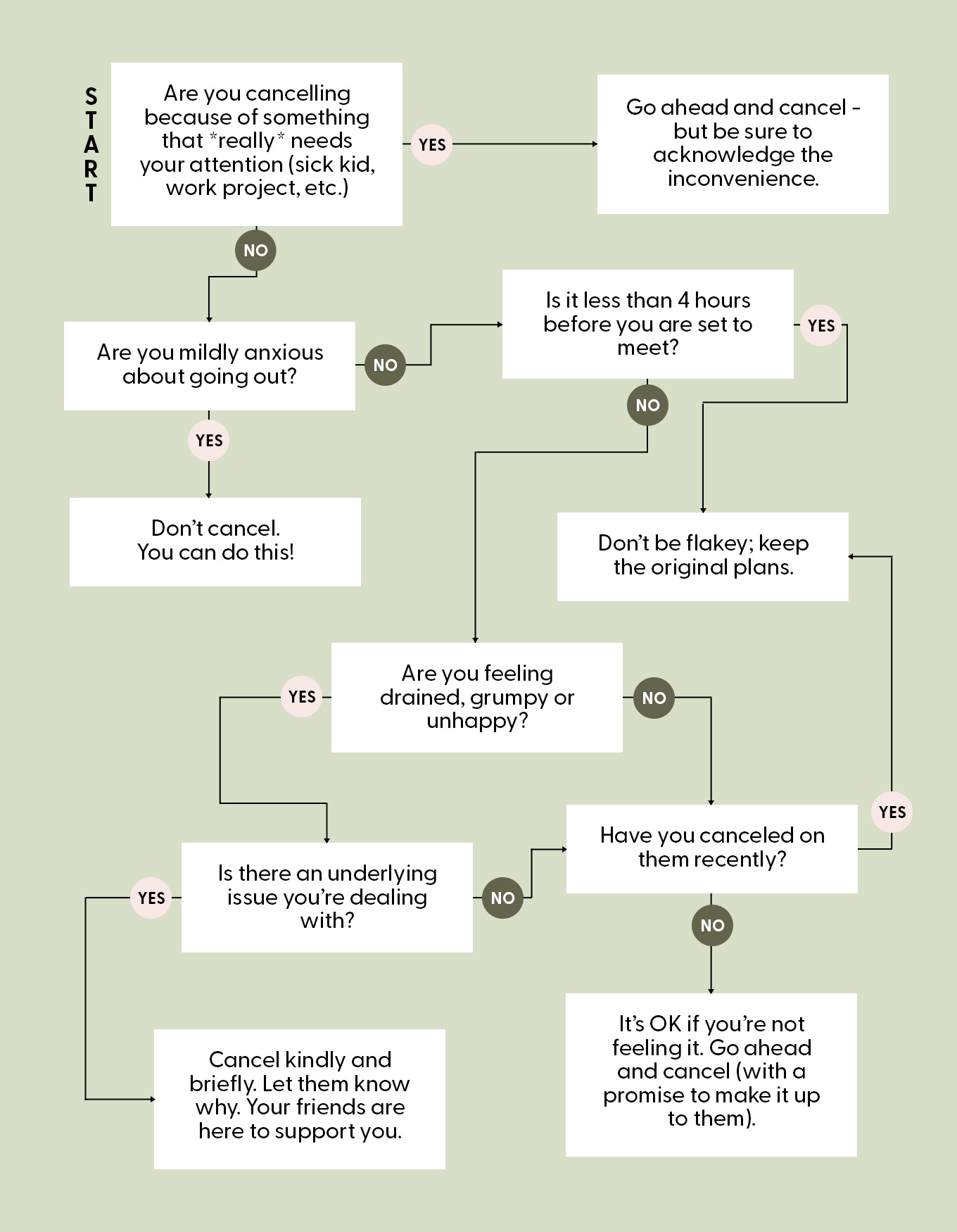
Of course, there are instances when canceling is OK. Generally, it must fall under force majeure: illness, family emergencies, (actual) work crises, dangerous weather. In Meier’s words, “Something truly urgent and unavoidable.”
How to Cancel Gracefully
Before you hit send on your text, consider this. Solit explains that if you’re planning to cancel due to anxiety or fear, reconsider before pulling out. “There is frequent value in pushing through it. I know many people who are anxious about going out to a get-together but feel better once they get out and socialize,” he says. “This is a great example of pushing through for your own benefit.
But if you really do need to cancel, tact matters. After all, someone is going to leave the conversation disappointed. Meier’s advice: “Keep it simple. A gracious script acknowledges the inconvenience but does not make excuses.”
Here’s her template:
“I am truly so sorry to do this, but I won’t be able to make it [on this date due to your circumstance]. I know you’ve planned for me, and I am upset to miss it. [Offer to reschedule and make it up to them.]”
Depending on time of life, everyone has a different approach to canceling. For parents, Meier advises building unpredictability into an RSVP, along the lines of “I’d love to come—I’ll confirm that morning once I know our childcare is set.”
Above all, she cautions that when canceling, remember that you want people to feel you are steady and reliable, so bear that in mind if you find yourself in a pattern of breaking off plans.
When Canceling Becomes a Problem
I once had a friend tell me that she’d let me know if something else came up when we were planning to hang out. Which was…not a boost of confidence on my end. Indeed, Meier notes that casual canceling leads to weaker relationships and breach of trust.
“When you say yes, someone is counting on you, she says. “It becomes inappropriate when: You receive a ‘better’ offer; you simply don’t feel like going; you’re tired but not unwell or you overbooked and are choosing between plans.”
There’s the idea that your friends will give you more grace, but repeated cancellations can erode trust in the friendship. And with acquaintances and professional relationships, there’s more on the line. “Reliability matters because your reputation is attached to your follow-through,” Meier says. “Younger generations prioritize boundaries and mental health (which is wonderful), but sometimes that value gets misapplied. Protecting your energy is important- but so is honoring your word.”